
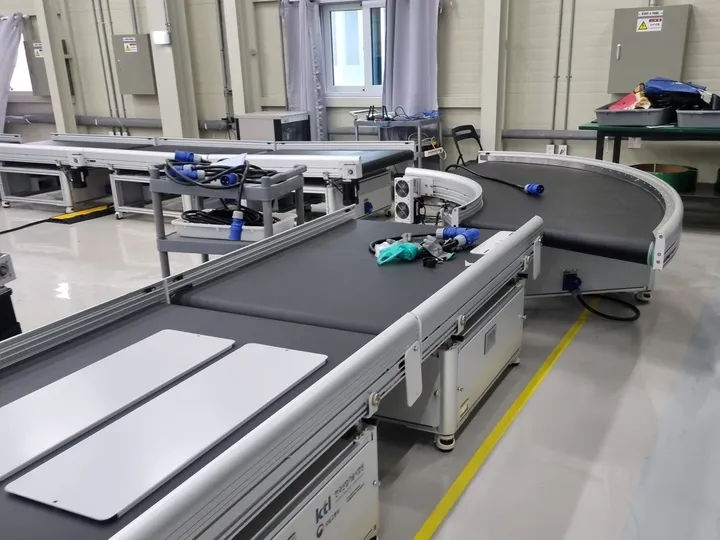
This is a modular conveyor belt system connecting straight, curved, and inclined conveyors.

Straight, Curved, and Inclined Conveyor Configuration
At the site, we applied straight conveyors for transporting goods, curved conveyors for changing direction, and inclined transfer modules for connecting areas with different heights.
Connecting Modules via Wi-Fi
Each conveyor module was connected through Wi-Fi wireless communication. This reduces complex communication wiring when adding modules or changing their positions.
The Wi-Fi control equipment uses a controller based on the Raspberry Pi 3 Model A+.
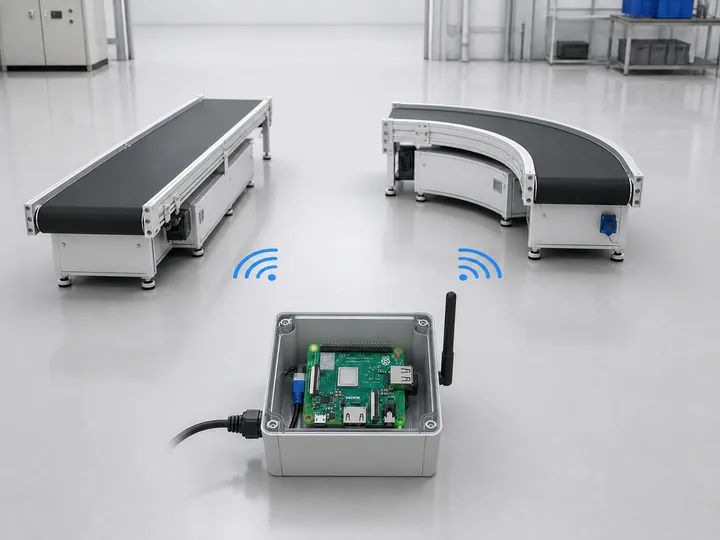
Concept image of a straight conveyor and a 90-degree curved conveyor connected via Wi-Fi
PC Integrated Control UI
From the PC integrated control UI, operators can check the operating status of the straight, curved, and inclined conveyors and control each conveyor module individually.
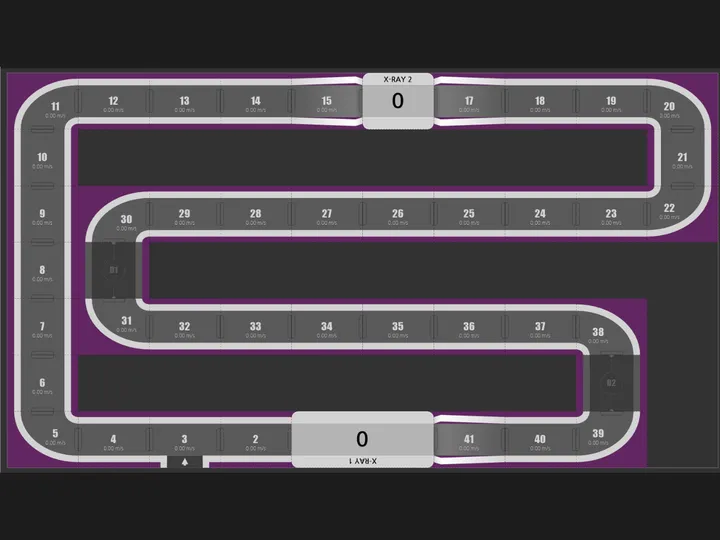
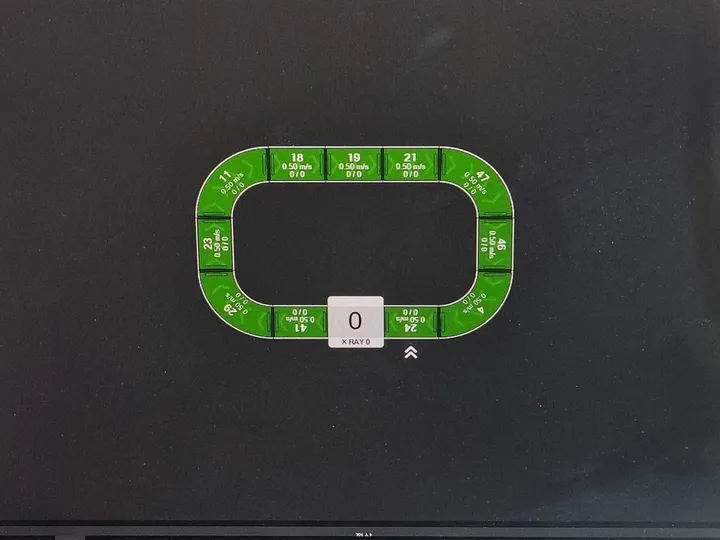
This is the screen used to monitor simple closed-loop control. The PC shows the speed received by the inverter and the number of the conveyor to be controlled.
iMaster-U1 Inverter and PID Speed Control
Each conveyor module is driven by a motor and an iMaster-U1 inverter. The conveyor belt transfer speed was controlled using inverter PID values.
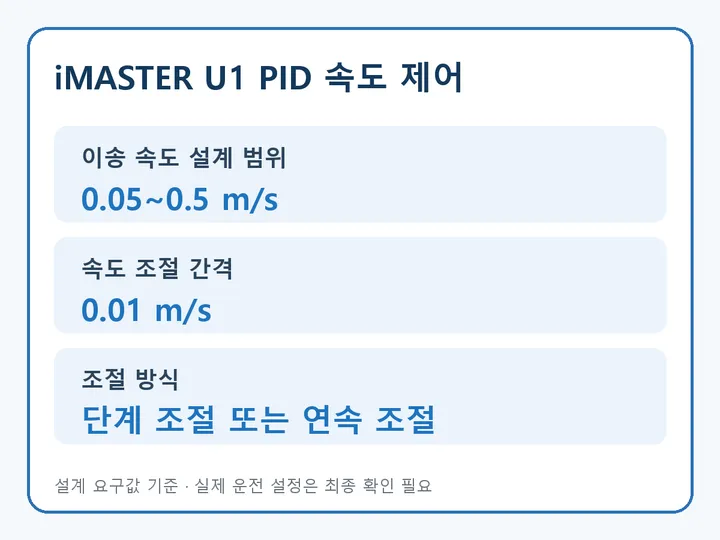
The designed transfer speed range is 0.05–0.5 m/s, configured for 0.01 m/s increments or continuous adjustment.
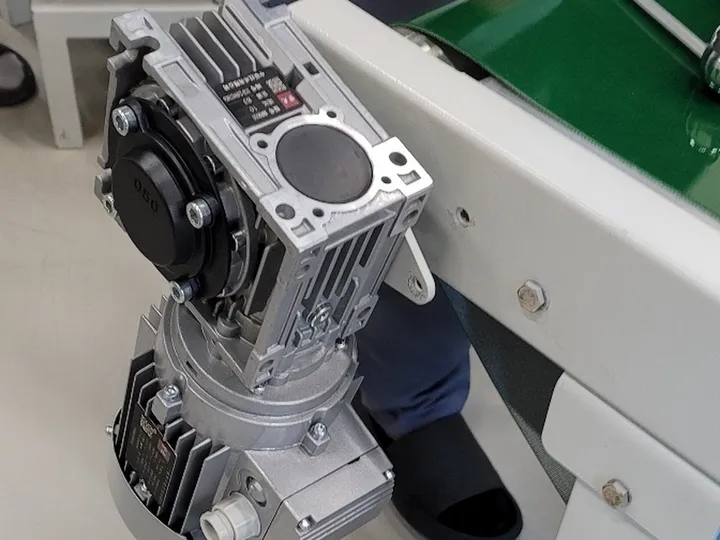
| iMASTER U1 Inverter | PID Speed Control Design Values |
|---|---|
 |  |
Non-Contact Object Detection Sensors
We used non-contact object detection sensors to detect transported items. Two sensors—an entry sensor and an exit sensor—were configured as one set to detect when an item entered and exited.
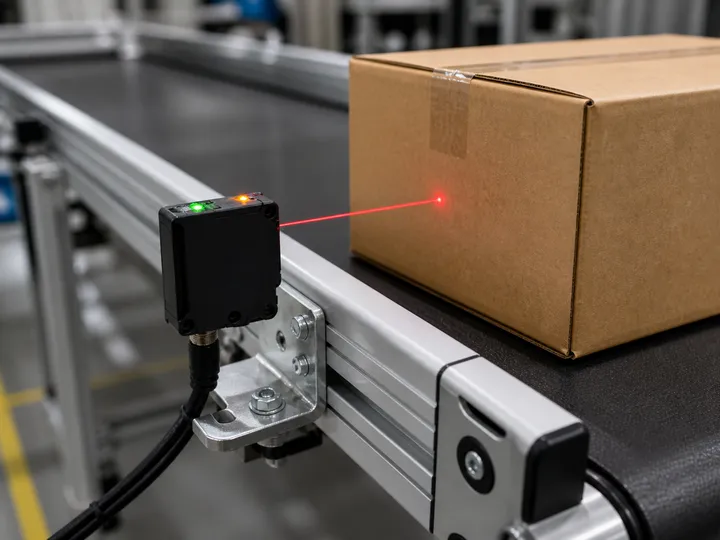
Concept image of transported-item detection using laser-type non-contact object detection sensors
Inclined Transfer Module
In areas with a height difference, we adjusted the height of an existing straight conveyor to create an inclined transfer module. Non-contact object detection sensors were also installed on the inclined transfer module to monitor entry and exit status.
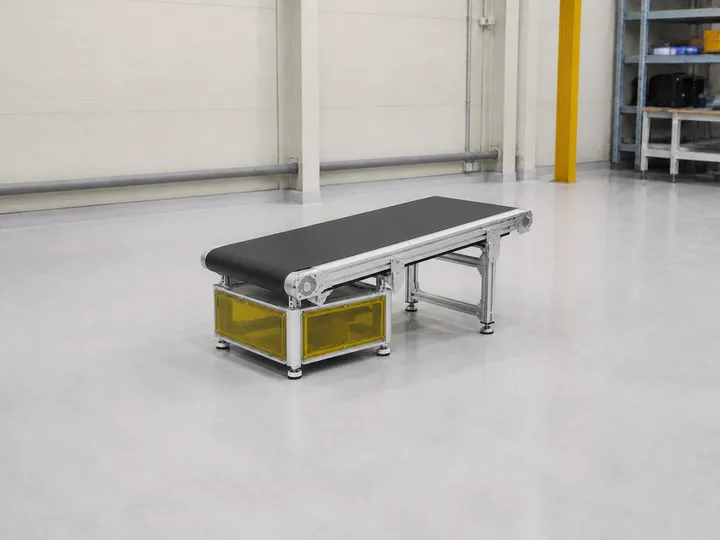
Concept image of an inclined transfer module created by adjusting the height of an existing straight conveyor
Conveyor Assembly and On-Site Installation
From curved conveyor assembly to installation beneath the conveyor and inspection of the drive unit, the work was carried out at the site.
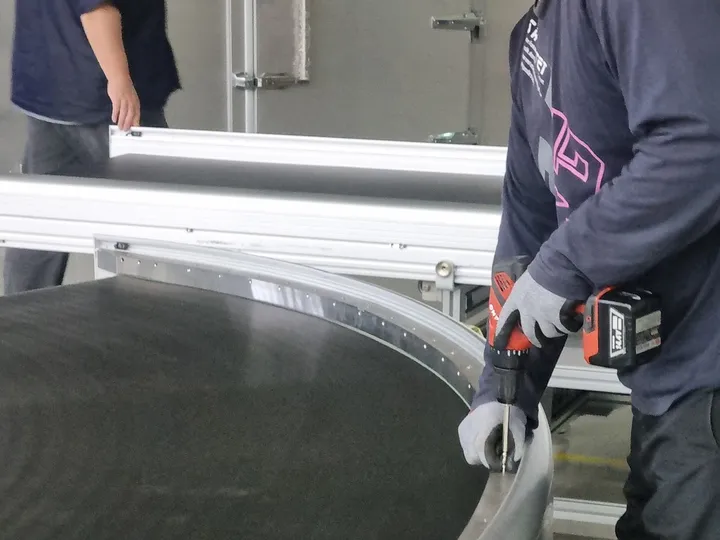
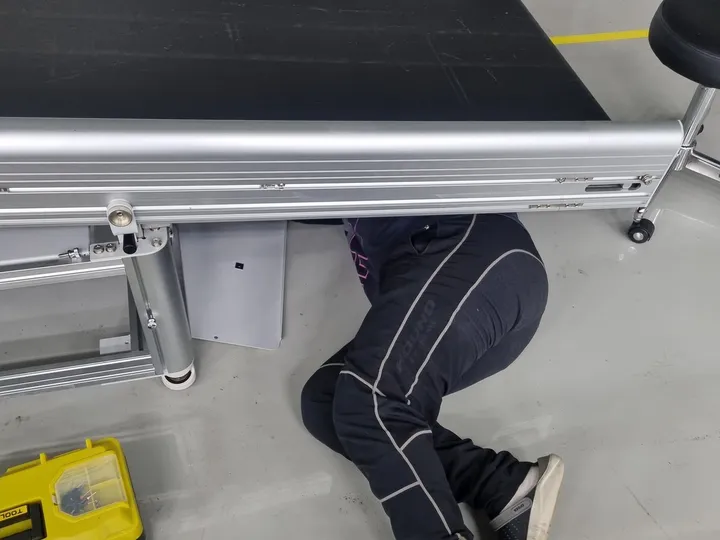
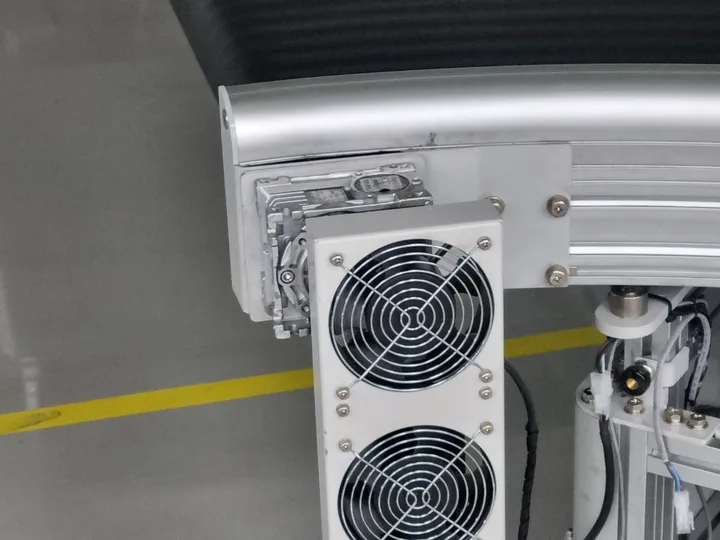
A cooling fan was applied to the conveyor drive unit.
Individual Straight and Curved Conveyor Tests
Before connecting the entire closed-loop conveyor, we separately conducted a curved conveyor operation test and a straight conveyor operation test.


After individual testing, the straight, curved, and inclined modules were connected into a single modular conveyor belt system.
Contact
- Email: [email protected]
- Instagram: https://www.instagram.com/going.sen/
- Website: https://intosen.com/kr/consult/
We will work with you to review a modular conveyor design and control method suited to your site configuration.
Comments
Enter a nickname to leave a comment, or sign in with Google or GitHub.